By Jethro Bovingdon
Special relationship
Formula One driver Ayrton Senna and Honda had a special relationship. Senna was a mercurial talent with almost otherworldly speed and a passionate determination that the sport had rarely witnessed.
Honda shared his desire to look beyond conventional limits and find engineering solutions that would prove decisive in the world’s most competitive motorsports discipline. Together they were an irresistible combination.
World champion
In 1989 Senna was the defending world champion and driving for McLaren-Honda. The previous season the combination of Honda’s 1.5-litre turbocharged V6 engine and McLaren’s MP4/4 chassis had been almost unbeatable – Senna and his teammate Alain Prost won 15 of the 16 races and the car remains the most dominant in F1 history.
For this new season there was a new 3.5-litre V10 engine (turbochargers were banned in 1989 to limit performance), but the success continued with McLaren-Honda winning ten races and both the Drivers’ and Constructors’ World Championships.
Rivalry
Behind the success was an uneasy relationship. Senna and Prost were rivals, and the only two realistic contenders to win the Drivers’ Championship.
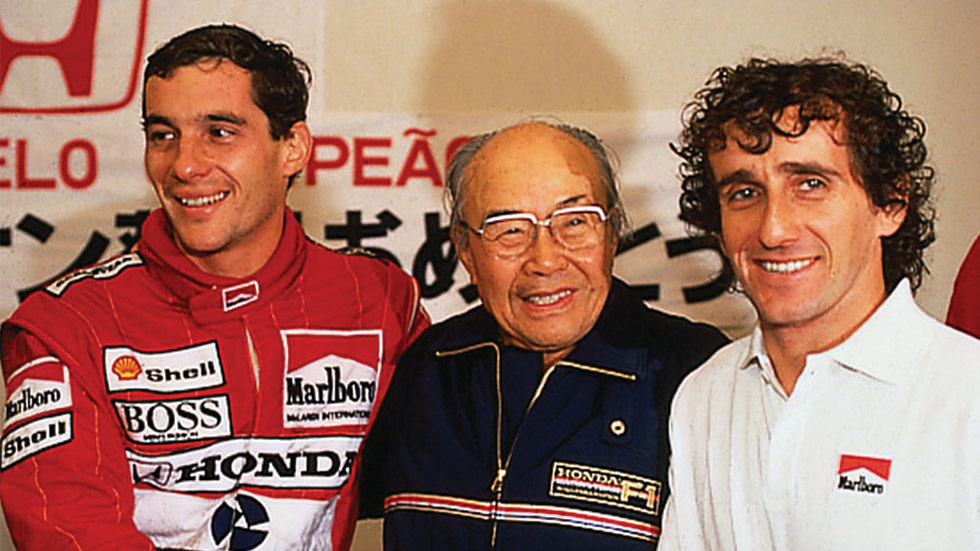
Soichiro Honda with his prized drivers, bitter rivals Ayrton Senna and Alain Prost
Nothing, however, could overshadow the driving skill that Senna displayed throughout the year. Perhaps his most impressive lap came in qualifying for the Japanese Grand Prix at the Suzuka circuit. It was the penultimate race of the season and Senna needed to win to keep his championship hopes alive.
In qualifying he decimated the field and shocked even Prost by posting a lap time 1.7 seconds faster than his teammate. In a sport used to separating drivers by tenths and hundredths of a second it was nothing sort of astonishing.
Senna at the wheel – recreated
Here, thanks to Honda’s pioneering use of telemetry in F1 – where sensors on the car transmit data back to the team in real time – the sound of that lap is recreated.
This incredible video, which utilises hundreds of LED lights and speakers to trace the car’s progress, was a joint project between Honda, Dentsu Digital and creative group Rhizomatiks.
In 2013 it was awarded the Grand Prize for the Entertainment Division of the 17th Japan Media Arts Festival and is a testament to one man’s ability to go beyond the edge and summon a performance that even his closest rivals couldn’t comprehend.